Now that the hectic holiday activities of Hanukkah and Christmas have come to a close and school is still out, kids have time to do some leisure reading. Below, three books that deal with time in various ways.Read More Source Link Books for Kids: A question of time
“We don’t inherit the earth from our ancestors; we borrow it from our children.” ~Native American Proverb
For years, I blamed my parents for my anxiety, my defensiveness, and my need to be right. Then I learned they inherited the same patterns from their parents. And theirs before them.
This wasn’t about blame. It was about breaking a cycle nobody chose.
The Stutter That Taught Me Everything
As a teenager, I developed a stutter. Not just occasional hesitation—paralyzing anxiety about speaking.
I’d anticipate making mistakes when reading aloud. Starting conversations felt like walking through a minefield. The fear of stuttering made me stutter more—a cruel self-fulfilling prophecy.
In college, studying psychology, I discovered something liberating. The anxiety about stuttering was causing the stuttering.
Once I learned to relax, breathe deeply, and stop anticipating errors, the stutter disappeared. Years later, I successfully presented high-stakes business proposals to executives. Not a single stumble.
I thought I’d conquered a personal flaw through willpower and technique. I was wrong.
The Discovery That Changed Everything
During college, I learned my father’s story. As a child, he had a lisp.
His father—my grandfather—thought it was hilarious. He’d make my dad recite tongue-twisters in front of family and friends. Highlighting his speech impediment for entertainment.
That cruel mockery created anxiety. That anxiety transmitted to me.
Different manifestation—stuttering instead of a lisp. Same underlying pattern: fear of speaking, anticipation of judgment, dread of being heard.
The medical field claims stuttering is genetic. But no gene has been identified. What I inherited wasn’t DNA. It was learned behavior.
My father’s anxiety about speaking became my anxiety about speaking. Not through genetics. Through observation, absorption, and unconscious imitation.
This realization brought us closer. We worked together in the family business after college.
Understanding this generational pattern created compassion between us before he died.
We Learn Who We Are from Birth
We begin learning emotional responses from our first breath. Our parents are our first teachers—not by choice, but by proximity.
We watch how they handle stress. Whether they express emotions or suppress them. How they react to criticism, disappointment, conflict.
These aren’t conscious lessons. Nobody sits down and says, “Today I’ll teach you anxiety.” We absorb patterns the way we absorb language. Through immersion.
Attachment theory tells us early bonds shape how we relate to others throughout life. If our caregivers were emotionally unavailable, we learned that seeking connection leads to disappointment. If they were unpredictable, we learned to stay vigilant, always watching for mood shifts.
These patterns feel normal because they’re all we’ve known. Like growing up in a house where everyone speaks softly—you don’t realize you’re whispering until you visit a family that talks at normal volume.
The Patterns We Inherit Without Knowing
I’ve spent twenty years in change management, helping organizations break dysfunctional patterns. The same patterns that cripple organizations cripple families. They transmit across generations like a computer virus copying itself onto new systems.
Anxiety and self-doubt.
Your parent worried constantly. Now you do too. You scan for danger even when there is none.
Perfectionism.
Nothing you did was quite good enough growing up. Now you drive yourself relentlessly. And criticize yourself harshly when you fall short.
Conflict avoidance.
Arguments in your house were scary—shouting, door-slamming, silent treatments. Now you’d rather suffer in silence than risk confrontation.
Emotional unavailability.
Your parents didn’t know how to talk about feelings. Now you don’t either. You change the subject when conversations get deep.
Boundary struggles.
You were told, “Family has no boundaries. We share everything.” Now you can’t say no. You feel guilty prioritizing your own needs.
These aren’t character flaws. They’re learned responses to the environment you grew up in.
And what you learned, you can unlearn.
Why Blame Keeps You Stuck
When I first understood my stuttering came from my father’s anxiety, I was angry. Why didn’t he fix himself before having kids? Why did he pass his damage to me?
Then I learned about his father’s cruelty. And I had to ask: was my father supposed to heal trauma he didn’t even recognize?
Blame requires someone else to change. But you can only change yourself.
Resentment hurts you more than them. It’s like drinking poison and expecting the other person to die.
Here’s the paradox: you can’t heal what you won’t acknowledge. But you can’t move forward while blaming.
The shift that changes everything: “This isn’t my fault. But it is my responsibility.”
Your parents couldn’t teach what they never learned. They did their best with what they inherited. Understanding that doesn’t excuse harmful behavior. But it creates space for compassion.
And compassion—for them and for yourself—is where healing begins.
The Pattern Recognition Practice
Change starts with awareness. You can’t interrupt a pattern you don’t recognize.
Here’s how to begin.
Identify inherited behaviors.
Ask yourself: What behaviors did I watch growing up? When do I sound like my parents—even when I swore I wouldn’t? What struggles did they have that I now face? For me, it was the anxiety about speaking. The anticipation of failure. The internal critic that said, “You’ll mess this up.”
Understand the committee in your head.
Those critical voices aren’t yours. They’re recordings of other people’s voices—parents, teachers, bullies, authority figures.
My internal voice said, “You’re going to stutter. Everyone will notice. They’ll think you’re stupid.”
That wasn’t me. That was fear I learned.
Catch yourself mid-pattern.
Awareness itself is the intervention.
When I felt anxiety rising before speaking, I’d pause. Notice the feeling. Name it: “This is the inherited pattern.”
Then breathe. Deeply. Three slow breaths.
That pause—between trigger and response—is where freedom lives.
Choose a different response.
You don’t have to react the way you’ve always reacted.
Instead of avoiding speaking situations, I deliberately practiced. Small presentations at work. Reading aloud to my son. Each time, focusing on breathing rather than anticipating errors.
The pattern weakened. The new response strengthened.
Just as you learned these patterns, you can unlearn them. With focus, time, and awareness.
The Gift You Give Yourself—and Your Children
Breaking inherited patterns isn’t just about healing your past. It’s about transforming your future.
Every time you interrupt an automatic response, you break the generational chain. You stop transmitting that pattern to your children.
My son doesn’t have speech anxiety. Because I didn’t model it for him. The cycle broke with me.
That’s the most profound gift: stopping the transmission.
You can’t change your parents. You can’t erase your past. But you can choose different patterns moving forward.
When my father and I worked together, understanding these patterns created a bridge between us. I stopped resenting him for what he couldn’t give. He stopped feeling guilty about what he’d passed down.
We both recognized we were doing our best with what we inherited. And we could do better for the next generation.
He’s gone now. But that understanding—that compassion—was healing for both of us.
Where Healing Begins
Your poor self-image isn’t your fault. Your anxiety, your perfectionism, your difficulty with boundaries—none of it is a character flaw.
These are learned behaviors. Inherited patterns. The emotional equivalent of your grandmother’s china—passed down through generations without anyone questioning whether you actually wanted it.
You didn’t choose these patterns. But you can choose what to do with them now.
Recognition is the first step. Not to assign blame, but to understand the mechanism.
Then comes practice. Catching yourself mid-pattern. Pausing. Breathing. Choosing a different response.
It won’t be perfect. You’ll slip back into old patterns. That’s normal. Progress, not perfection.
But over time, the inherited patterns weaken. Your conscious choices strengthen.
And one day, you realize that critical voice is quieter. That anxiety is manageable. That automatic reaction doesn’t feel so automatic anymore.
You’ve broken the cycle.
Start Today
Choose one inherited pattern you recognize. Just one.
This week, notice when it shows up. Don’t try to fix it yet. Just notice.
“There’s the perfectionism.”
“There’s the conflict avoidance.”
“There’s the need for approval.”
Awareness is where change begins.
These patterns took years to develop. They won’t disappear overnight. But they will change. Because they’re learned behaviors. And what you learned, you can unlearn.
Your struggles aren’t character flaws. They’re inherited patterns. And patterns can change.
Mike Palm is a change management consultant with over 20 years leading transformation across 60 corporations. After discovering his stuttering was inherited anxiety from his father—who inherited it from his grandfather—he developed frameworks for breaking generational patterns. He leads a nonprofit supporting 12-step programs and is the author of The Legacy of Emotionally Immature Parents. Learn more here.
After Jamina Bone gave birth to her second child, she was hit with strong postpartum depression, also known as PPD.
“It went from a very educational approach where I was constantly looking up the ‘best’ way to handle every aspect to being unable to move,” Bone told Bored Panda. “I used to plan activities, limit screen time, and make every opportunity a learning moment. I was a Special Educator before having kids so this was everything I wanted and felt equipped to do it all. When PPD hit, it was like wading through mud or even quicksand and still being expected to do all the things.”
She felt broken, unworthy of being a mom for her perfect little beings, and selfish for wanting to get away. “I kept the negative thoughts in my head and often imagined terrifying things from hurting myself to the death of my baby. Being isolated the first several months and lack of sleep were definite factors that played into depression but also not dealing with the sudden death of my mother in law to cancer when I was pregnant. I didn’t realize these were risk factors.” The woman didn’t realize she was depressed. She just thought she was failing.
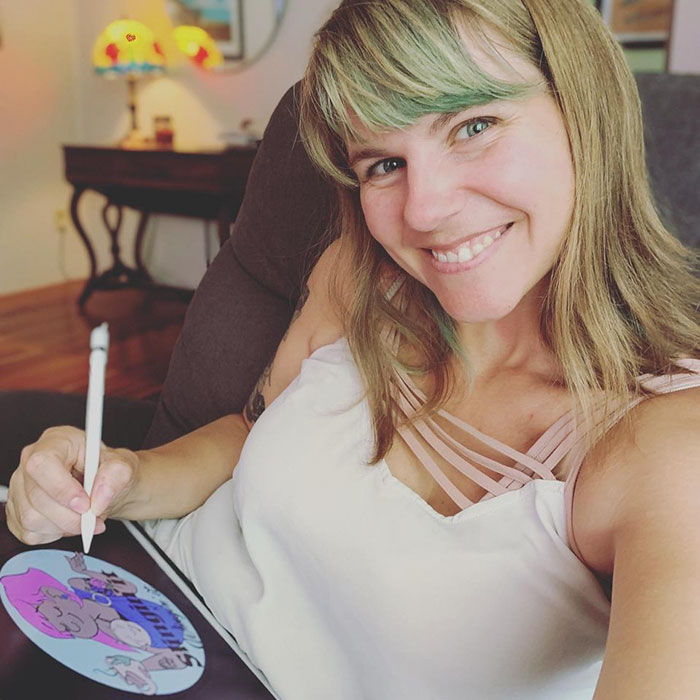
Over time, however, Bone has managed to get out of the rut. Now, the mom-of-two is encouraging “imPERFECT moms” to ditch social norms and embrace their true badass selves. One of the ways she’s doing it is illustrating everyday situations. Through her pictures, Bone reminds people that a woman can have doubts and still be a good mom. She can feel disappointed and still be a good mom. Most importantly, she can be herself, forget the pseudoperfect happy-go-lucky mentality and still be a good mom.
“We moms are bombarded with the ‘proper’ ways to parent from Google to Pinterest and perfection-blasted on social media,” Bone said. “We share baby milestones with our friends and loved ones, but forget to discuss the difficulties of parenthood. Well, let’s be real, motherhood. The mother is expected to give 100% of her body, most of her time, and the majority of her mental energy planning for the what-ifs and all the needs. Community is lost, support is seen as weakness, and if you’re depressed, you’re seen as ungrateful and selfish.”
Bone thinks we are a society that lifts the ‘selfless’ behavior of mothers up on pedestals while condemning the ones who are crying for help. We don’t realize that we confuse selfless with self-hate or self-contempt. “My mother was selfless, but I would also say she hated her body, felt unlovable, and rattled with guilt for not seeing abuses that happened to her children,” Bone explained. “She used so many opportunities to punish herself from not dating, not taking care of her body, to even shaming herself in front of us.”
So, like most adults with children of their own, Bone finds herself trying to correct the wrongs. “Many of us built our adult foundation upon trauma without realizing the need for internal healing. Weirdly enough, depression was my unwanted ‘gift’ that forced me and my family to sort through every aspect in our lives that wasn’t working in our favor. We set boundaries, went to therapy, talked to our doctors, and closed the door on every external expectation for our family.”
The down-to-earth mom describes her parenting as ‘good enough’ and says she is still a work in progress. “I am healing myself and trying to break the cycles of abuse and neglect my husband and I collectively had in our childhoods. I zone in on my own set of values of what I am good at. My kids feel safe and held and seen and heard, and as long as I am moving forward in my own parenting journey, I am good enough,” Bone explained, adding that she and her husband communicate more now than ever which also helps share the burdens and joys of parenting.
Bone said that one of the most important steps towards overcoming the overwhelming feeling of guilt is celebrating your victories. “I developed a simple online quiz to help mamas find what they are good at. This quiz leads you to know the values that are most important to you so you can learn to turn off the feeling of guilt when you see a Karen posting her gluten-free, no-sugar-added snacks with her home-cooked meals cut out in cute shapes that her kids never complain about after having organized homeschool activities, teaching writing to her 1-year-old because it’s never too soon to learn writing.” Knowing that Karen has different strengths and values than you is key.
“I’m also creating a mental health makeover for exhausted mamas coming out soon! I am really proud of this one and even received input from a psychologist specializing in maternal mental health to be sure I was helping and not hindering growth. To sit in the lies fake mom guilt leads us to believe, we often become friends with those voices and we don’t know who we are without them. We begin to believe the lies over the truth and over time we forget who we are or who we are becoming. Knowing where to start in order to move past these limited beliefs can be debilitating.” This makeover, called “Enough” essentially takes mamas through 5 weeks of progress and habit building based around healthier thoughts, taking control of triggers, and finding a balance that is doable.
It doesn’t come as a surprise that we and our parents at our age are light-years apart. When it comes to our lifestyles, choices, and values, it seems like we were born on different planets. But there’s only one way to find out what exactly was so different for them than it is for us now, and it’s looking at hard evidence, aka photo albums.
With so much free time on our hands during this festive season in quarantine, the chances are you’ll stumble upon one or two great pics that will bring out a blast from the past. And people on Twitter are all in for the “My Parents Vs. Me” challenge, posting snaps of family members where age is the only parallel you’ll find.
We have selected some of the cutest, funniest, and most illuminating posts that show how generations have changed. And after you’re done, don’t forget to check out Bored Panda’s previous post with “Me Vs. My Parents” memes that put a comical spin on these generational differences.
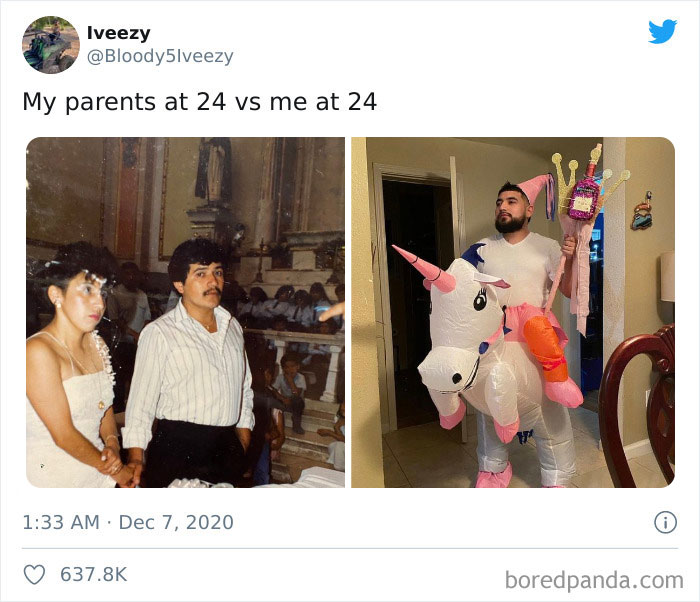
“In my opinion, a big difference is how relaxed we are. We don’t care what people will say, it’s not all work. We have a big emphasis on living life, being happy, and having fun.”Iveezy also said that so many people related to the challenge because “we are all tired of the assumption that everyone wants to get married and have kids.”
For him, being a first-generation Mexican American, it’s almost taboo not to want a big religious wedding with lots of kids. “And my picture says the complete opposite: ‘I’m just a 24-year-old Mexican that likes whiskey dressed like a unicorn and I’m not worried about anything.’”
When asked what kind of challenges Iveezy’s generation has to face, the social media influencer said it’s information. “In my parents’ day, you were limited to who you knew and what you knew about them. Relationships are so hard now because someone will always tell your partner ‘oh yeah, I’ve seen them before with so and so’ or ‘yeah, I’ve heard of ’em, have you seen his tweets?’”
“Besides the social aspect, our parents didn’t know what depression or anxiety was. They felt the symptoms, but didn’t recognize the condition,” Iveezy explained. Meanwhile, “my generation does and if I know I’m depressed, the last thing I’m worried about is marrying someone, so yeah, information is our double-edged sword,” he concluded.
The feeling that our millennial generation and our parents are worlds apart is not just all in our heads. In fact, the generational differences can be even bigger than one would expect.
Over the past 50 years, cultural, social, and economic shifts have paved the way to the modern day, where the youngest millennials have now become adults. Today, they make up the second-largest generation in the US electorate, hence the Democratic leanings compared to previous generations.
According to Pew Center, “Today’s young adults are much better educated than their grandparents, as the share of young adults with a bachelor’s degree or higher has steadily climbed since 1968.” 4 in 10 millennials have a bachelor’s degree or higher.
However, the financial well-being of millennials is very complicated. “The individual earnings for young workers have remained mostly flat over the past 50 years. But this belies a notably large gap in earnings between millennials who have a college education and those who don’t.”
Pew Research showed that millennial workers with some college education made $36,000, lower than the $38,900 that baby boomer workers made in 1982 when they were the same age.
And since millennials were hit hard by the great recession, they are much slower in forming their own households. As a result, many still can’t afford their own houses and are forced to live with their parents or in flat-shares. The young generation is also forming families much later than older generations, as the “Me vs. My Parents” challenge has shown.
Pew Center suggests that the share of adults who have never married is increasing with each successive generation. “If current patterns continue, an estimated one-in-four of today’s young adults will have never married by the time they reach their mid-40s to early 50s—a record high share.”
Kids are the wonders of this world. Nobody really knows what’s on their mind, as they often come up with some very questionable decisions.
Like hiding stuff from their parents for undetermined reasons. And by stuff, we mean anything from ravioli and tomato stem circles to photographs, mobile phones, and you name it…
Let’s see what else parents had to say when someone asked the question “What are your kids currently attempting to hide from you?” and posted it on r/AskReddit. And while the “why?” part of the question may forever remain a mystery to us, it’s still amusing to see what our little ones have been up to without us knowing.
Click here & follow us for more lists, facts, and stories.
#1
My two year old attempts to hide the family dog (who is 75 pounds) in various places in his room so that the dog can sleep in there with him. So far, I’ve found the dog in the closet, behind the curtains, surrounded by stuffed animals to “blend in,” and on numerous occasions I’ve walked in the room to see a giant mound under the comforter at the foot of the bed. My son is astonished every single time that I have not only found the dog, but was even looking for him in the first place. On more than one occasion he even attempted to persuade me that he didn’t even know we had a dog.
My kid would get up in the middle of the night and want a snack. He would sneak into the kitchen and eat a whole tomato except the little circle where it connected to the stem. He hid the little stem circles under whatever was on top of the trash and would go to sleep. We always made sure there were tomatoes for him.
My nine year old step daughter was in her room one day for like hours with markers and papers. I thought she was drawing or making a picture book or something so I let it slide. It turns out she had our calendar and was making cards for everyone for every holiday and birthday coming up. I haven’t asked her about it but I’m honestly super proud of her logic and long term planning abilities.
To find out more about hiding behavior in children, Bored Panda reached out to Kimberly Koljat, a licensed marriage and family therapist who specializes in children 3–12 years of age and believes that anyone can benefit from the work of the creative arts.
Kimberly said that first of all, the context of hiding behaviors is extremely important for understanding a child’s needs. “Developmental age, what is being hidden, relationships, and communication skills are important considerations.”
For example, “If a teen is hiding something from their parents, like objects in their room, they could be playing out behaviors related to a developmental task of ‘individuation,’ or working on their sense of identity separate from their caregivers.”
#4
I thought my 15-year-old was diligently plugging the charger into her phone every night before going upstairs for bed…until I discovered she was actually plugging it into an empty phone case and taking her phone with her
My 16 y/o had a box of condoms with a price sticker from the Dollar Store in his backpack, he left it on my passenger seat and they fell out while I was shifting it to the back seat. I went and bought him a better brand and replaced them. We have never discussed it Edit- Thank you all so much for the great feedback, parenting is no easy task lol. To clarify, we have discussed s*x, I only meant that we’ve never discussed the actual switching of the condom boxes
#6
I found a loaded one-shot Nerf gun under my 5-year-old daughter’s pillow. When I asked her what she was doing with it, she whispered, ‘It’s for the tooth fairy
Meanwhile, if a child is hiding a photo of their grandparents they cherish, it can be part of “a soothing skill to hold onto their memory related to grief if they passed, or to carry the feeling of them with them while they’re apart,” explained Kimberly.
If a younger child is hiding candy, it could deal with “children testing limits with their caregivers (an important part of development for some children, exploring what boundaries are in place).”
It also depends on what kind of objects your child is hiding, Kimberly says. “Hiding food can be an entirely different behavior, and it’s important to know if there’s previous traumas, such as food scarcity in the family, or if there are other behaviors related to food to consider that could be indicators of disordered eating.”
#7
A few years ago, I was going through my son’s (3rd grade) backpack and found a can of ravioli. That’s all well, except I never bought any ravioli. When I asked him about it, he burst into tears and and pulled out a box under his bed filled with Ravioli! He then proceeded to tell me how this girl that picks on him and says they are married gives him ravioli everyday and makes him take it. I can just picture this girl’s mother telling her the way to a man’s heart is through his stomach.
We had a foster kid who hid about two handfuls of spaghetti with sauce under his pillow. We found it the next day while he was at school, cleaned it up, and never told him we found it. But we made sure to have spaghetti twice a week after that.
My daughter is trying to impress me by learning origami. She’s 7 and doesn’t think that Dad can see all the missing paper and the (messily but improving a lot) paper cranes hidden throughout her room. I bought 2 more reams of paper and just left them out on accident. Lazy old dad not putting up his office supplies.
However, if a caregiver notices a pattern of hiding behavior, parents should “never directly move to reprimanding or punishing a child or directly questioning a child about it.” Kimberly explained that adults’ means of expression and conversations will most likely not yield the results they wish for because children work through difficulties in their play.
Kimberly suggests joining the child in play and leading a play session once a week with them. “The child may gain that sense of agency they could be seeking through the hiding behaviors and stop the behaviors outside the play sessions.”
Most importantly, parents should always stay curious about their child’s behavior. Kimberly urges parents to “spend some more positive time with the child to foster a greater sense of trust within the relationship.” In some more difficult cases, the support of a therapist may be the right solution.
#10
My 3-year-old nephew opens a bag of Lay’s and sneaks two chips, then sneaks two more the next day, and so on. I will never have that kind of self-control.
I just found out that my six-year-old locks the bathroom door so he can get some privacy. Last night I looked across the kitchen to see the door slightly ajar and my son engaging in his private time. Doing push-ups. I didn’t say anything, just watched him finish his 5 reps, flex in the mirror and then walk out of the bathroom.
#13
My daughter has a picture of her mother and I on our honeymoon. Been “hidden” under her bed for a long time. We’ve been divorced over 4 years now. She still keeps that picture under her pillow every night. It’s still there actually. I don’t have the heart to take it from her. Too bad her mother is a cold hearted blood sucking two faced w***e. Tough to see every time it I change the sheets.
#14
My daughter throws her lettuce under the table for the dog to eat. The dog doesn’t like lettuce.
My daughter has a stash of “candy” wrappers under her bed. She is 4 and thinks she’s slick. The “candy” is dried prunes though. I put those in the candy jar because she kept stealing candy.
#18
Conversation with daughter: “Ok, so while I was changing your sister did you finish dinner” “Yes daddy” “ALL of it?” “Yes” “So if I look in the garbage can I’m not going to find any of your dinner in there?” [Silence]
#19
My 6 year old got out of bed early on Sunday morning to sneak downstairs and steal Monopoly money from the bank in the unfinished game from the night before which was left out on the table.
Fortunately my teenager (16, going on 17) doesn’t try to hide much from me. She’s a terrible liar and gets busted right away every time, so she just casually admits stuff these days. It’s pretty great. However, she’s been sneaking her boyfriend over to the house during the day while I’m at work and thinks I’m clueless. Girl, I know you eat a lot, but there’s no way you’re going through half a loaf of bread by yourself in one day. You also left his glass of water on the coffee table…
Himself. It’s nearly bedtime. 2 year old thinks I’ll forget to put him to bed if he runs into another room for 30 seconds.
#23
Our son (9) is taking his marbles to school and s******g other kids out of their marbles. He’s got a real hustle going on there. He’s not allowed to take any toys to school, hence why he’s hiding it. I checked his school backpack and found probably a kilogram worth of marbles in there. We are having a talk this afternoon.
#24
My almost 2yo has started telling me crazy stories as if they are real. He recently told me that our dog rides a motorcycle to go play with her friends.
#25
My kid is 5. She sneaks food under her blanket (wrapped snacks) for later and is always amazed when I find them.
#26
My daughter (who’s 9) thinks she’s being crafty hiding a book under her pillow to read after bedtime. I’ve known for about a year and let her have half an hour ‘secret reading time’ after she goes to bed. Bit harder to know if she’s not reading after half an hour now it’s summer and she doesn’t need to use a lamp, but I can tell if she’s turned her lamp off in winter.
#27
My two year old dropped out Echo dot and split into two pieces. She attempted to sandwich it back together and put it back where it was but now says stuff like “alexa play mickey mouse” and then when nothing happens she says “uh oh alexa what happen?” You know d**n well what happen and it’s HAPPENED.
#28
My 12(m) son went on a double “date”. My husband happened to be driving through town and saw the 4 of them together. I asked him and he said they “happened to be going to the same place”. The mother of the other boy had the scoop and filled me in. I let my son know that he shouldn’t lie to me and it is perfectly fine for him to be going on a double date – he apparently paid for the fries. I offered to drive him and the others somewhere if they wanted to go again.
#29
My 22-year-old son starts work at 6:00 a.m. He left the house at 6:30 and came back thirty minutes later. I think he got fired.
#30
My 6 year old son poops in the back yard every morning and blames it on the dog
“Sometimes you will never know the value of a moment until it becomes a memory.” ~Dr. Seuss
The notification pops up on my phone: “Jason, we made a new memory reel for you.” I pause whatever I’m doing, probably something stressful involving deadlines or dishes, and feel that familiar flutter of excitement. What chapter of my life has Google decided to surprise me with today?
I tap the notification, and suddenly I’m watching years of Father’s Day adventures unfold. It started accidentally—one Father’s Day trip to the Buffalo Zoo that somehow became our tradition. Instead of buying me something I didn’t really need, we chose experiences. Year after year, we’d visit a new aquarium or zoo.
There’s my son at age three at the Erie Zoo, barely tall enough to see over the penguin exhibit barrier. The same kid at five at the Baltimore Aquarium, tentative but overjoyed as he touched a stingray for the first time. Then six at the Philadelphia Zoo, taking in the fact that there is a tube system where some of the big cats can walk overhead.
Buffalo, Erie, Philadelphia, Baltimore, Charleston. We’d mapped Father’s Days across the Eastern Seaboard without ever planning it. So much time has passed since we started. My son has grown taller, lost teeth, found his voice. I’ve gotten balder, maybe a little softer around the edges. But there we are, year after year, choosing moments over things.
We tell ourselves to create experiences instead of accumulating stuff, but just how important that choice is never really hits until you play it back. Here was the proof: a memory bank I didn’t even realize we were building, one Father’s Day adventure at a time.
The emotions hit in waves. Pure joy at his excitement over feeding the stingrays, happy sadness watching his younger self discover jellyfish for the first time, overwhelming gratitude for every single trip we took. This ninety-second reel has become medicine for whatever current stress I’m carrying.
And that’s when it hits me. My phone accidentally became my therapist.
When Technology Gets It Right
I never intended for Google Photos to become part of my self-care practice. Like most people, my wife and I take hundreds of photos without much thought, letting them pile up in digital storage. The idea of actually organizing or regularly looking through them feels overwhelming. Iƒt feels like thousands of images scattered across years of living.
But then technology stepped in with an unexpected gift. These automated memory reels started appearing, curating my own life back to me in perfectly sized emotional portions. Not the entire overwhelming archive, just a gentle serving of “Remember this?”
At first, I was skeptical. Another way for a tech company to keep me glued to my screen when I routinely looked for ways to escape. But as these memory notifications became part of my routine, I realized something profound was happening. Google’s algorithm had accidentally created something I never knew I needed: regular reminders of how blessed my life has been.
The beauty is in the surprise element. I’m not seeking out specific photos when I’m feeling down. That can sometimes backfire, making me feel more nostalgic or sad. Instead, these curated moments arrive when I least expect them, like getting a text from an old friend who you haven’t heard from it a while.
The Science of Digital Reminiscence
Research shows that positive reminiscence (deliberately recalling happy memories) can significantly improve mood and reduce stress. When we engage with positive memories, our brains release dopamine and activate the same neural pathways associated with the original experience. We literally get to relive moments of joy.
Visual memories are particularly powerful. Studies in cognitive psychology reveal that images trigger stronger emotional responses and more vivid recall than other types of memory cues. When we see a photo from a happy time, we don’t just remember the moment. We can almost feel ourselves back there.
Nostalgia, once thought to be a purely melancholy emotion, is now understood to be a powerful mood regulator. Research from the University of Southampton shows that nostalgic reflection increases feelings of social connectedness, boosts self-esteem, and provides a sense of meaning and continuity in our lives.
But what makes these digital memory reels especially effective is that they’re unexpected and brief. Unlike deliberately scrolling through old photos (which can sometimes lead to rumination or sadness), these automated highlights arrive as pleasant surprises and end before we get overwhelmed.
The timing is often perfect too. These notifications tend to pop up during mundane moments, like waiting in line, taking a work break, sitting in traffic. Exactly when we need a little perspective on what really matters.
The Emotional Range of Remembering
Not every memory reel hits the same way. Some make me laugh out loud, like the diversity of my son’s increasingly elaborate Halloween costumes or the series of failed attempts to get a decent group photo at our destination wedding. Others bring that “happy sadness” I’ve come to appreciate… seeing my grandmother in photos from a few years back, her smile bright even when her health was declining.
Then there are the reels that just make me feel deeply grateful. The random afternoon when we decided to try goat yoga. The collection of action shots over the years: chasing my son around the house in a homemade superhero costume, his skateboarding phase, catching up with friends we haven’t seen in some time. These aren’t momentous occasions, just evidence of a life filled with small adventures and genuine connection.
What strikes me most is how these photos capture joy I might have forgotten. In the daily grind of parenting, working, and managing life, it’s easy to remember the stress and overlook the sweetness. But here’s photographic proof: we’ve actually had a lot of fun together.
The reels remind me that while life hasn’t been all butterflies and rainbows, the good has consistently outweighed the tough times. The visual evidence is overwhelming. We’ve been blessed, again and again, in ways both big and small.
Embracing Digital Self-Care
I’ve learned to treat these memory notifications as legitimate self-care appointments. When that notification pops up, I pause whatever I’m doing and give it my full attention. No multitasking, no rushing through. I let myself feel whatever comes up. The giggles, the happy sadness, the overwhelming gratitude.
Sometimes the timing feels almost magical. The day my social anxiety took over because I had to present during three different meetings, a reel appeared featuring peaceful moments from the trip my wife and I took to Newport, Rhode Island (mostly so I could try a lobster roll). When I was worried about whether I was doing enough as a parent, I was served a compilation of my son’s biggest smiles over the years.
It’s become a form of mindfulness I never planned. These brief interruptions that pull me out of current anxiety and remind me of the bigger picture. They’re proof that I’ve been present for beautiful moments, that I’ve prioritized what matters, that love has been the consistent thread running through our ordinary days.
The Memory Bank We Don’t Realize We’re Building
Those Father’s Day zoo trips felt routine at the time. Just something we did because that’s what families do on special days. I wasn’t thinking about creating lasting memories or building traditions. I was just trying to make sure my son had a good day.
But now I see what we were doing, and that was making deposits in a memory bank that would pay dividends years later. Every photo was evidence of intention, of showing up, of choosing joy even when life felt overwhelming.
The beauty of these digital memory reels is that they reveal patterns we might not see in real time. They show us that we’ve been more intentional than we realized, more present than we felt, more blessed than our current mood might suggest.
The Gift of Automated Gratitude
In a world where technology often leaves us feeling more anxious and disconnected, these memory reels offer something different: automated gratitude practice. They’re gentle reminders to pause and appreciate not just where we are, but where we’ve been.
They don’t require apps to download or habits to build. They just arrive, like grace, when we need them most.
So, the next time you get one of those memory notifications, pause. Let yourself be surprised by your own joy. Look at the evidence of love in your life. The big moments and especially the small ones. Notice how much good has happened, even during life’s inevitable challenges.
Your phone is holding more than photos. It’s holding proof of how blessed your life has been.
And sometimes, that’s exactly the reminder we need to keep building that memory bank, one ordinary, beautiful day at a time.
Jason Hall is a writer, mental wellness advocate, and professional overthinker who believes in the power of imperfect faith, a well-timed joke, and the occasional snack-fueled epiphany. He writes about finding light in the messy middle of life and the small, stubborn joys that help us float through. You can find him at chilltheduckout.com, where he shares stories about stress, hope, growth, and how to chill the duck out one microjoy at a time.